Pogue Press Job (RedM) (Vorp)

// SYSTEM DESCRIPTION
Pogue Press Job — Write, Print & Publish Your Story 📰📖
“Every town has rumors. Every outlaw has a legend. Every character deserves a written legacy.”
Pogue Press brings a complete document writing, reading, printing, and publishing system to your RedM server.
Let players create books, letters, newspapers, and journals with a detailed vintage-style editor built for immersive roleplay.
From private letters and personal diaries to printed newspapers and published books, Pogue Press turns simple stories into physical items that can be read, copied, sold, and shared across your world.
📺 Info
🎥 Video Preview: https://www.youtube.com/watch?v=lgyny4qNcoE
💬 Need help? Join our Discord for setup support.
📌 Discord: Join our Discord
📸 Screenshots
❓ What is this?
Pogue Press is an advanced document creation and publishing system for RedM.
Players can write and design different types of documents such as:
Books
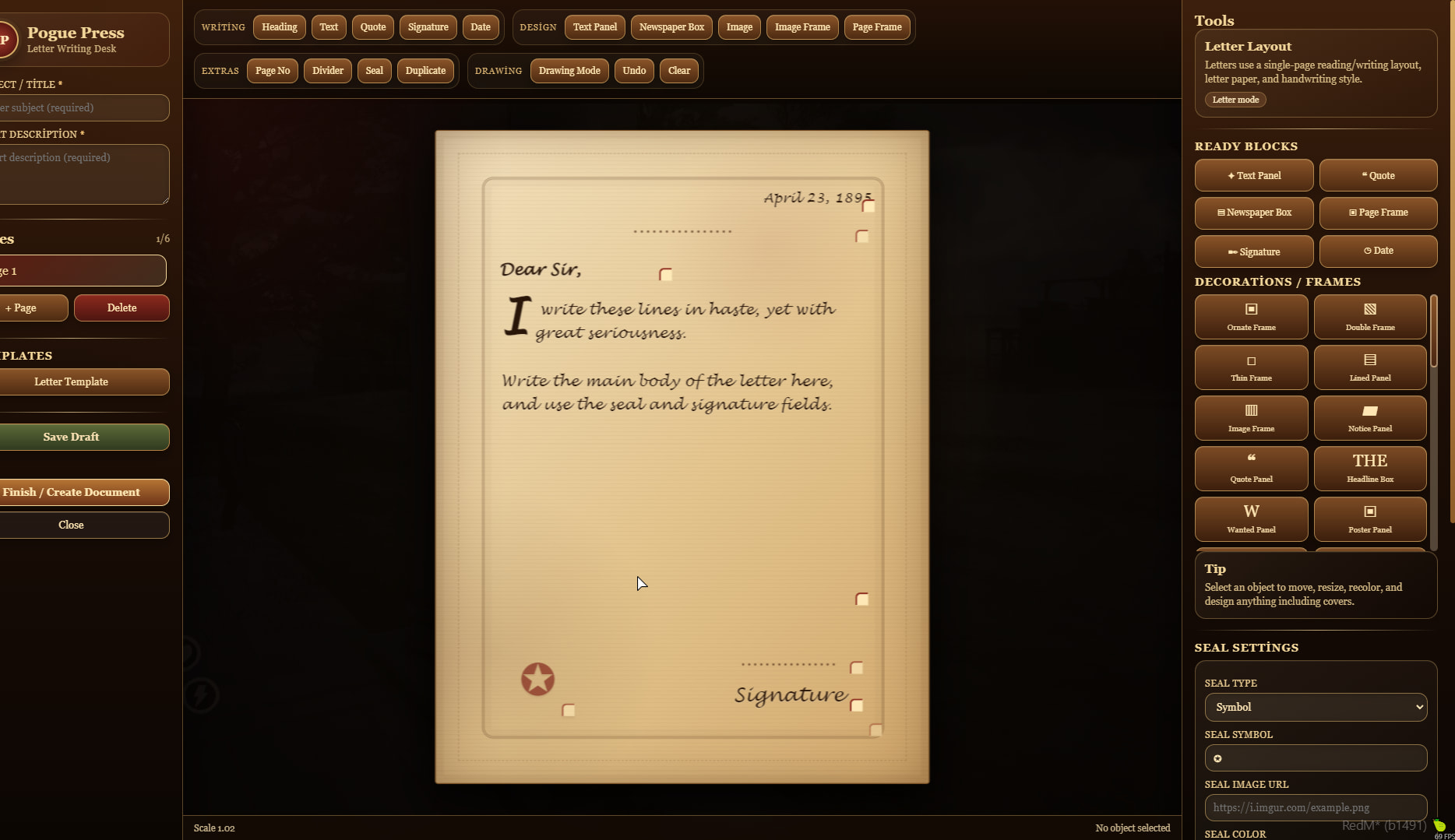
Letters
Newspapers
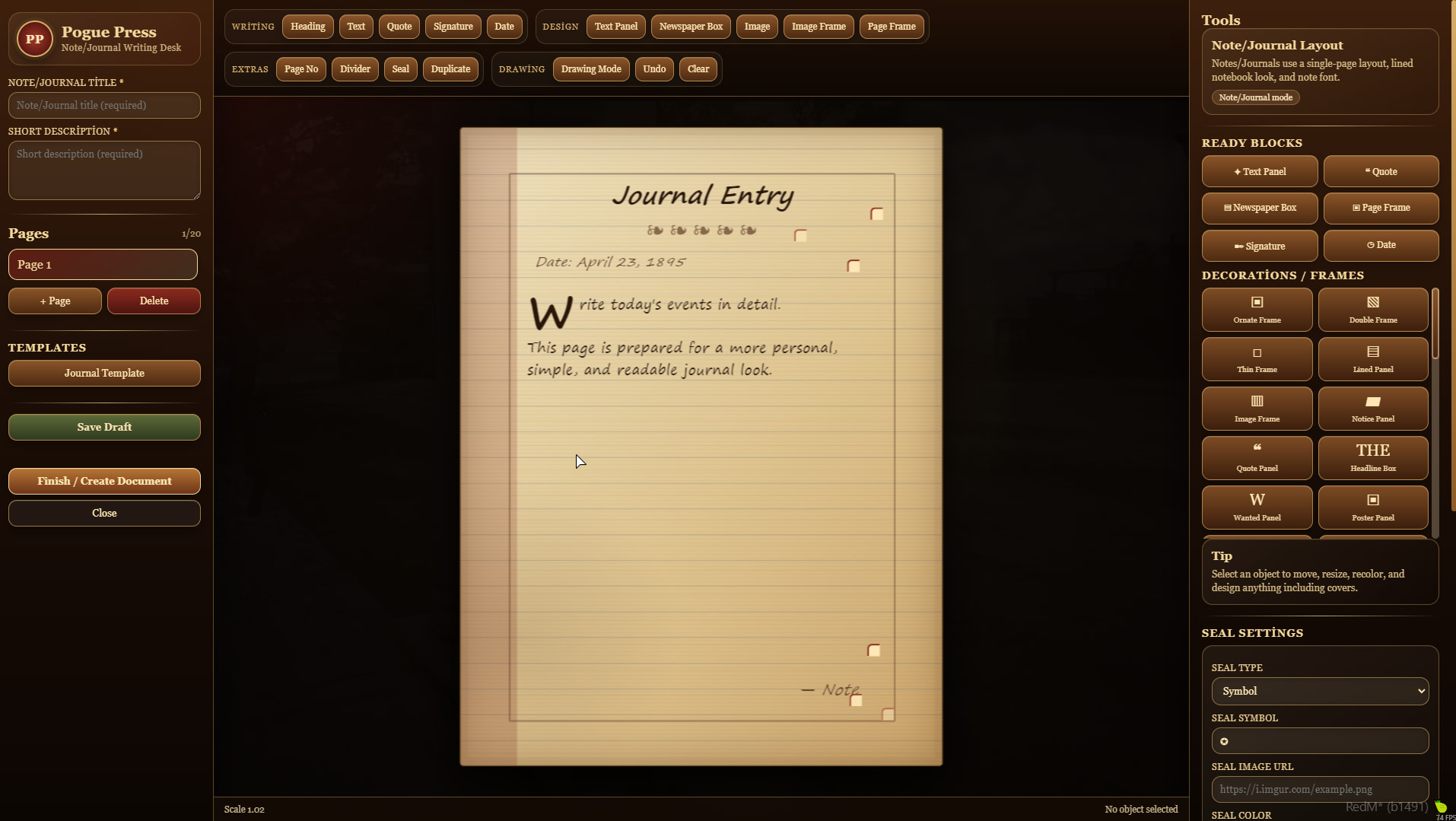
Journals
Each document can be created through a vintage editor, saved as a written item, opened from the inventory, printed at configured press stations, and even listed for sale in a public publishing market.
The system is designed for roleplay servers that want deeper storytelling, player-made history, newspapers, books, official letters, faction records, personal journals, and in-character publications.
Whether your players are journalists, writers, sheriffs, politicians, merchants, investigators, or simple townsfolk with a story to tell, Pogue Press gives them the tools to make that story part of the world.
⭐ Key Features
📖 1. Multiple Document Types
Pogue Press supports several document types, each with its own style and purpose.
Players can create books for long stories, letters for personal communication, newspapers for public announcements, and journals for personal records or character development.
Each document type can use different blank and written inventory items.
✍️ 2. Advanced Writing Editor
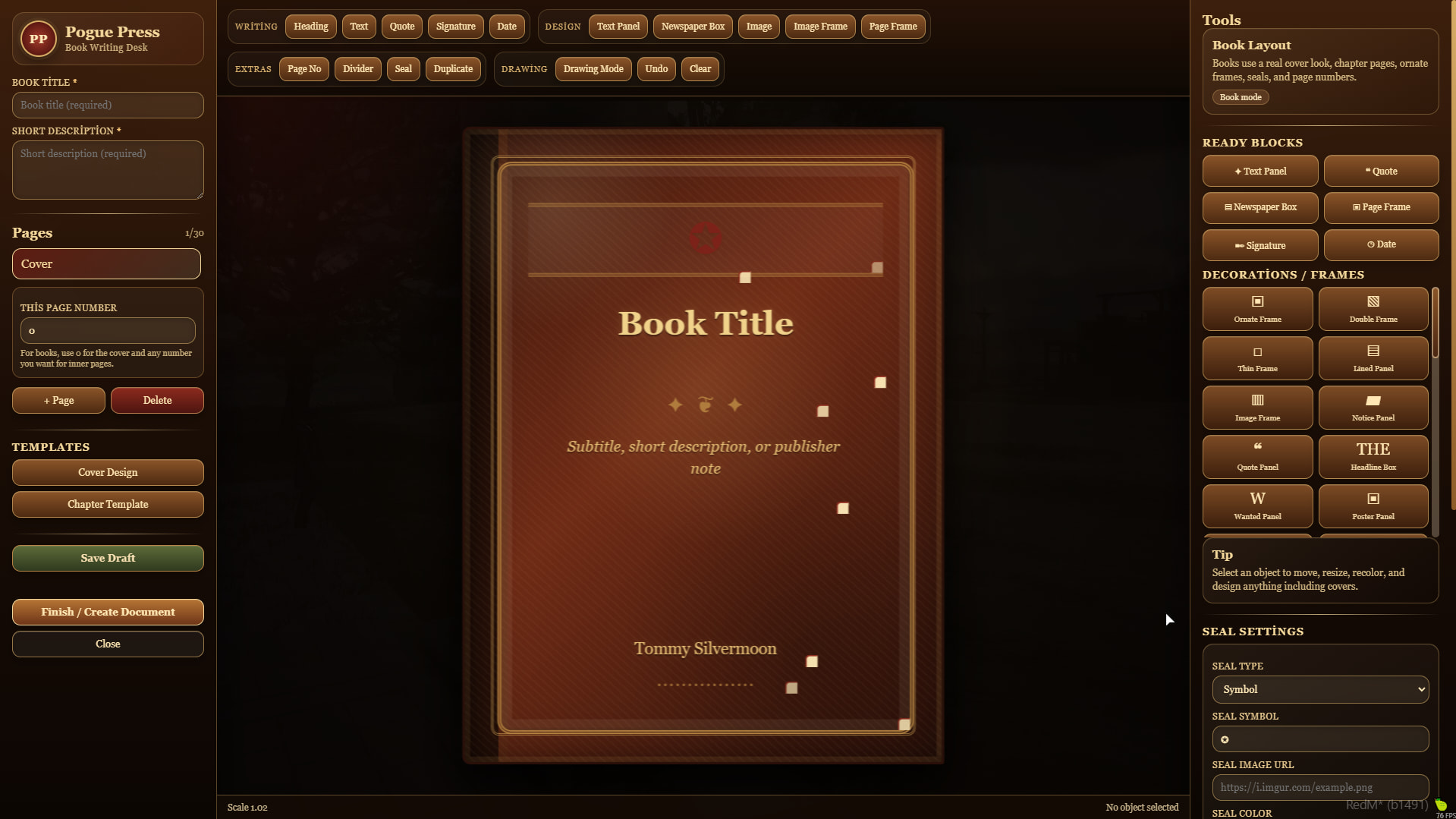
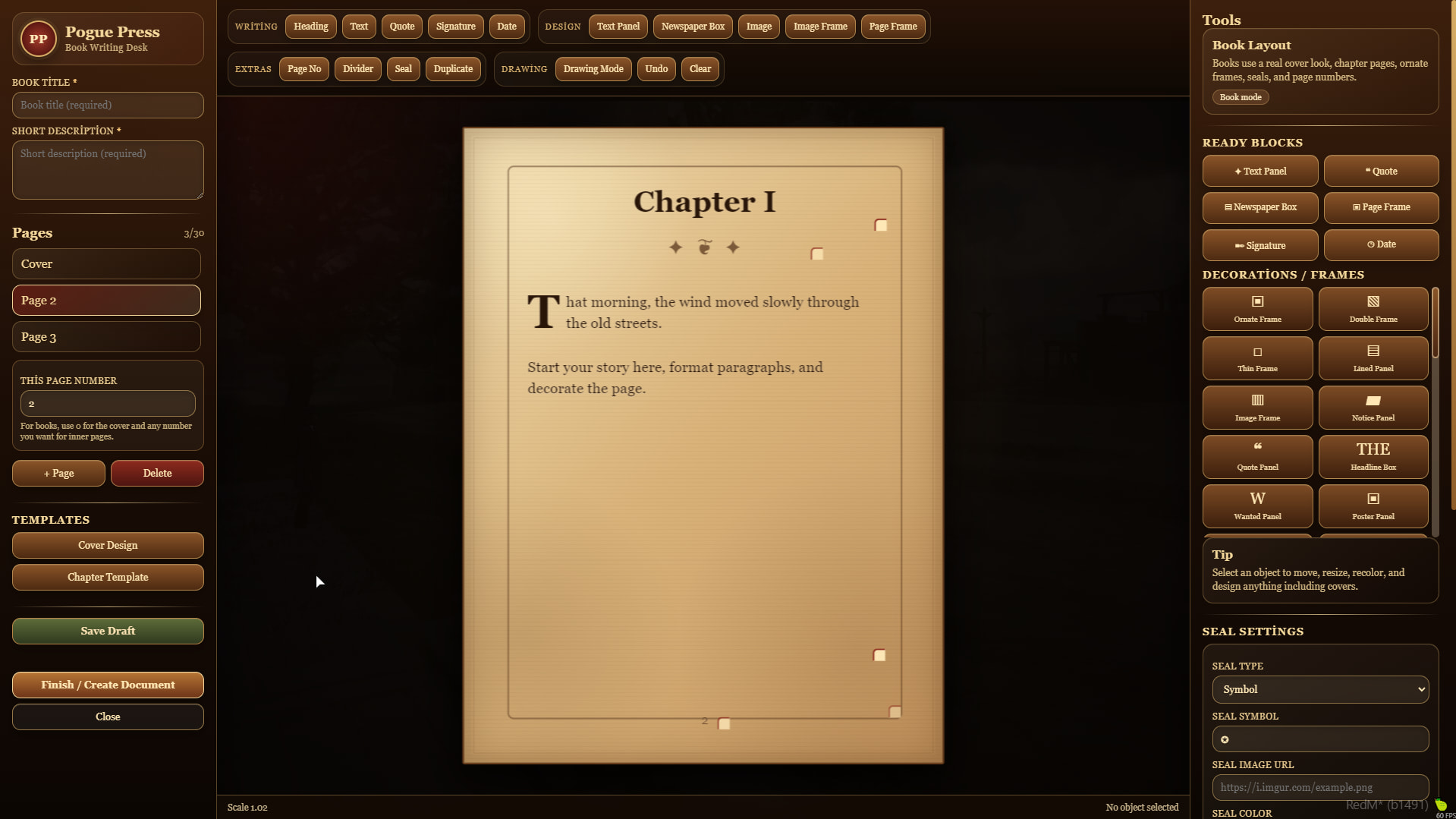
The editor allows players to build detailed documents page by page.
Players can add headings, normal text, quotes, signatures, dates, page numbers, dividers, frames, and more.
This makes every document feel unique instead of being just a simple text box.
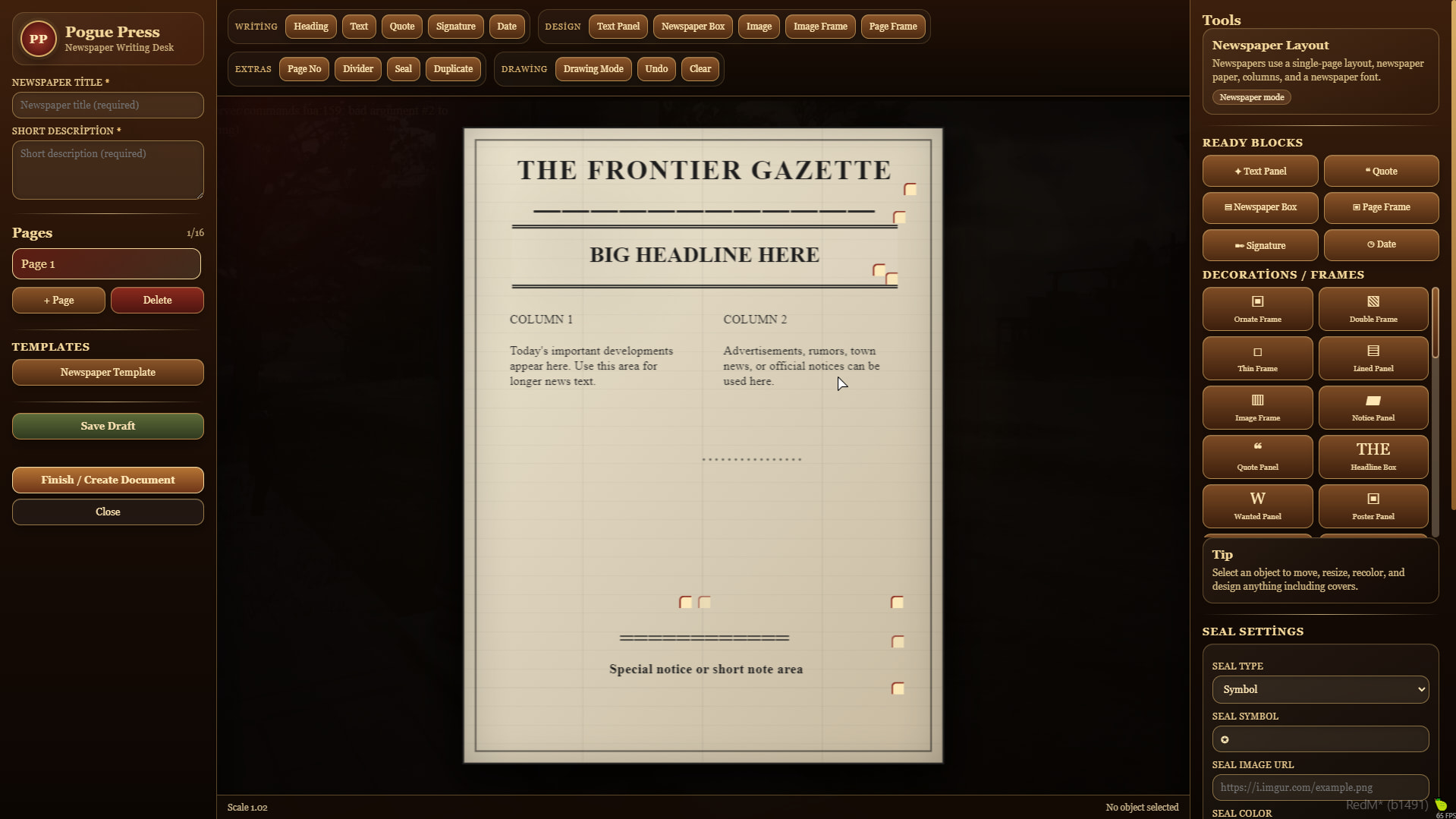
📰 3. Newspaper, Letter, Book & Journal Templates
Pogue Press includes document-focused templates to help players create immersive layouts quickly.
Books can have covers, newspapers can use newspaper-style layouts, letters can look more personal, and journals can feel like private handwritten records.
This helps players create better-looking documents without needing to design everything from zero.
🖼️ 4. Image Support
Players can add image links into their documents if enabled in the config.
This can be used for posters, wanted notices, newspaper images, family crests, maps, symbols, or decorative roleplay content.
Image usage can be controlled through config limits and optional domain whitelist settings.
🖌️ 5. Drawing Mode
Pogue Press includes a drawing system inside the editor.
Players can draw directly onto pages, undo strokes, clear drawings, and create more personal or handmade-looking documents.
This is perfect for signatures, marks, sketches, symbols, rough maps, or roleplay decorations.
🔖 6. Seals & Official Marks
The system supports seals that can be used inside documents.
Seals can be configured globally or assigned by identifier or character ID.
This is useful for sheriff offices, government documents, mayoral papers, noble families, press organizations, or private factions that want official-looking documents.
💾 7. Draft System
Players do not have to finish everything in one session.
Pogue Press supports saving unfinished work as drafts.
Drafts can be reopened later, allowing players to continue writing longer books, newspapers, or journals without losing progress.
🎒 8. Inventory-Based Documents
Blank document items are used to create new documents.
Finished documents become written inventory items with metadata such as title, author, description, and document type.
Players can open written documents directly from their inventory and read them in a clean reader interface.
🖨️ 9. Printing House System
Published documents can be printed at configured printing stations.
Servers can set printing costs, required paper items, maximum copies, access rules, NPCs, blips, and station locations.
This allows newspapers, books, letters, and journals to be physically copied and distributed through roleplay.
🏪 10. Public Publishing Market
Pogue Press includes a market system where documents can be listed for sale.
Players can sell their published works through configured market locations.
Other players can browse listings, buy documents, and receive a readable copy in their inventory.
This creates a player-driven publishing economy.
💰 11. Commission & Treasury System
Market sales and print fees can generate location income.
Configured jobs can access the treasury/cashbox and withdraw money from press or market locations.
This makes publishing houses, newspapers, and book markets useful for server economies and roleplay businesses.
👥 12. Job & Permission Support
Document creation, reading, printing, selling, buying, and withdrawing can be controlled through config.
For example, newspapers can be restricted to a news job, printing can be limited to press workers, or market selling can be open to everyone.
This makes the system flexible for different server styles.
🧍 13. NPCs, Blips & Native Prompts
Printing and market stations can have NPCs, blips, and native RedM prompts.
Players can walk up to a publishing location, interact with the station, open the print menu, browse the market, or access the treasury if they have permission.
This keeps the system immersive and easy to use in the world.
🎨 14. Vintage UI Design
The interface is designed to fit RedM roleplay servers.
The editor, reader, print menu, market panel, and treasury panel all follow a vintage-inspired visual style.
The goal is to make writing, reading, printing, and publishing feel like part of the western world instead of a modern menu.
🌍 15. Locale Support
Pogue Press supports configurable language text.
Menu labels, notifications, buttons, prompts, and UI text can be translated and adapted for your community.
This makes the system easier to use for English, or any other language setup.
⚙️ 16. Fully Configurable
Most important parts of the system can be adjusted through config files.
You can configure document types, item names, editor limits, page limits, image settings, commands, prompts, print stations, market stations, permissions, treasury jobs, NPCs, blips, notifications, and more.
Pogue Press is built to fit different roleplay servers instead of forcing one fixed setup.
🖥️ What Players See
Vintage document editor
Book, letter, newspaper, and journal creation
Page list and page editing
Title and description fields
Text, heading, quote, signature, and date tools
Image and image frame options
Page frames, dividers, seals, and page numbers
Drawing mode
Draft save option
Reader interface for finished documents
Printing menu
Public market panel
Seller balance withdrawal
Treasury/cashbox panel for authorized jobs
⚙️ Configurable via Config
Language / locale
Debug mode
Document types
Blank and written item names
Item-use permissions
Read permissions
Editor page limits
Text and image limits
Drawing limits
Required items for writing
Paper usage per page
Image link whitelist
Commands
Keybinds
Native prompt labels
Notification functions
Print stations
Print costs
Required paper per copy
Maximum copies
Printing permissions
Market stations
Market price limits
Market commissions
Selling and buying permissions
Treasury withdraw jobs
NPCs and blips
Seals by identifier or character ID
🧠 Roleplay Possibilities
Pogue Press is more than a writing menu.
It can support:
Player-written newspapers
Government notices
Sheriff office reports
Wanted posters
Private letters
Character journals
Lore books
Investigation files
Religious texts
Business contracts
Family records
Political propaganda
Published stories
Town announcements
Market-sold books and newspapers
A journalist can publish the latest town scandal.
A sheriff can issue an official notice.
A writer can sell novels.
A mayor can stamp documents with an official seal.
A character can keep a private journal of their journey.
Pogue Press gives your players a way to leave written history behind.
🧠 TL;DR
Create books, letters, newspapers, and journals.
Design pages with a vintage editor.
Add text, images, drawings, seals, frames, and templates.
Save drafts and continue later.
Turn finished work into readable inventory items.
Print copies at press stations.
Sell documents through public publishing markets.
Generate commissions and treasury income.
Customize permissions, jobs, items, prompts, stations, NPCs, and language.
Pogue Press turns player stories into physical history.